skip to main |
skip to sidebar
So I’m just gonna say it…car restoration projects take up a lot of room. I don’t think I was naïve to this fact prior to starting this adventure, but it never really hit me until I was looking through the photos I’ve taken during this intrepid journey.
Let me paint the picture for you:
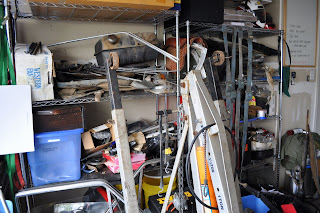
We have a two-car garage that is currently functioning as a storage space and workshop space as well as a home for The Gearhead’s motorcycle. We have a short two-car driveway. We live in a duplex townhome community. Hence we have a home owner’s association that has a lot of rules. Rules like “thou shall not park your car on the street for more than seven days at a time” and “thou shall not make a lot of noise” etc, etc, etc.
Not the makings for the best case car restoration project scenario. For all the lists and plans that we have made before and during this month, one thing we did not take into account is the work space. Well, I take that back some…we knew it was small and not ideal, but we really didn’t have any other choice so we worked with what we had. But I think we could have taken a more methodical approach not only to where we worked, but how we worked as well.
My advice to Gearhead’s with confined working spaces is this:
1. Try to remove everything that isn’t related to the car project. Is there any place else you can store the boxes of holiday stuff and camping gear? Some options would be to rent a storage unit for a while; the cost may well be worth it. Or even moving some of that seasonal stuff into an unused spare bedroom? You can shut the door and just forget about it till the project is done. This is bit of a pain in the beginning, but so worth the extra room during the project!
2. Pare down the tool selection. If you have a tool collection anything like The Gearhead, you don’t need them all for this job, so it may be worth the extra room to just box up the tools that you won’t use and put them in that unused bedroom with the rest of the rejects.
3. Set up the tools that you will use. Hang them on the wall so you can to make use of your vertical space.
4. Remember to return the tools to their spot on the wall at the end of the night. The Gearhead argues with me on this one, so let me clarify a bit. I'm not talking about the wrenches and sockets and stuff that you are using all the time. It's just as handy to have them right on the floor next to whatever you are going to do next. But the stuff that isn't used often...just get it out of your way.
5. Have a designated space for the stuff that comes out of the car. Seatbelts, mirrors, dash pads, headlights…there’s so many little things. We set up two steel shelving racks on one side of the garage to house all this stuff. Again, makes use of the vertical space and clears the floor. It still looks like a mess, but at least it’s all together in one spot and you don’t have to worry about tripping over anything.
6. Moved finished pretty parts to a clean room. When we upholstered the door panels, there was no way I was going to let them live in the greasy, dirty garage while the rest of the car got overhauled. The dust alone would have killed all our hard work. So they currently live in that unused spare bedroom, safe and sound. If you must leave them in the garage, cover them with a tarp or blanket.
And take this advice for what it’s worth. We certainly don’t have all the answers! Ultimately, you need to find the working style that fits you. But I think these suggestions can only help in the long run. Do you have any tips to share?

Originally posted in January 2006 on The Gearhead’s blog Seeing the World Past the Bug-Splattered Windshield and re-posted here in it’s unaltered entirety (except for five wee typos that my English minor background just could not leave alone) with permission from The Gearhead because the more Opelers in the world, the merrier!
Opels are interesting cars. They were imported and sold through regular Buick dealerships all over the US from about '57 to '75. That's a pretty good run, all things considered, roughly equivalent to how long Hyundai, Acura, Lexus, and Kia have been selling now. That's long enough to have purchased one as your first car going off to college, then as your second car because of brand loyalty when you needed something bigger for your new family. As they were pretty solidly engineered cars, with decent features and in the last few years excellent handling, there's a few of those folks still around. They are all by now 50-somethings set in life with the kids out of the house and some $ to spend these days bringing back a long lost friend from the dead.
But they also sold a lot of them, and they are all 30+ year old cars now, and new they were the cheapest cars GM sold here in the US and advertised everywhere as such. Which means they aren't particularly worth a lot. That brings an entirely different demographic under the "Opeler" umbrella, the folks who have an Opel strictly because it's cheap. These are the folks who squirm at the idea of an "expensive" $500 paint job or $800 5-speed transmission upgrade. (Well worth every penny, by the way.)
So what do you get into when you join the Opel community, then, with these two completely different demographics dominating the scene? Strangely enough, unlike most other similar marquees you get an amazingly open, helpful, friendly group of folks that'll usually give you the shirt off their back if you really need it. See, unlike the MG, Triumph, Corvair, Jaguar, Fiat, Morris Minor, Etc... groups, the Opel community was all but abandoned for the better part of 20 years here in the US. In 1975 you could get parts at any Buick dealership or parts store. By 1995, I had to drive all over Houston to find a valve cover gasket on short notice, and to get the "good" ones I had to agree to buy all 50 of the minimum batch Fel-Pro would make to get them ordered for me. We would have all given up on our Opels and tossed them into the crusher if it weren't for the internet and the new-fangled shrinking of world economies it provided. This orphaning, though, made for a remarkable tight group of old-timers, and they smack the kids into decent people before they associate with them.
So, now maybe you've decided you want to look into buying an Opel yourself? How does one go about doing it these days? There are club listings, and E-bay, and the like, but they do occasionally show up even in the local paper. Here's how my last purchase went:
Looking through the paper, stumbled across an "1975 Opal wagon for sale, $250" ad. The obvious (to an Opeler) misspelling of Opel was sure to keep the usual Opel vultures away, and the price was so low the car was obviously junk or the seller didn't know what they had. Either way, well worth the look anyway just-in-case. Called the seller, set up a time, and went to look at the car. Those of you familiar with the ritual of buying an old car know all the usual stuff that happens during that first meeting:
-"Is this the car for sale?"
-"Yep, that's the one."
-"Have you had it long?"
-"No, not long, only (yada, yada, yada) Got it as a project and not going to get around to it."
-"I see, did it run well when you bought it?"
-"(It doesn't really matter, just trying to see if they feel bad for it going down the tubes or good for restoring it some.)"
-"It looks like just about what I was looking for, I was hoping for (whatever) though." (sigh)
-"That would have been nice for sure."
-"Is $250 your bottom dollar?"
-"I could probably let you have it for $200."
-"Thanks, let me go get the $ and my trailer."
Next thing you know you'll be bringing home a car in need of some work for sure, but worth more to your friends in parts than what you paid for it complete. Sure $500 would have been a bargain, but no arguing that $200 is a lot better, right? Besides at $500 you might have to consider the Karma check and the rest of the VW Idiot's Guide's pre-buying techniques, whereas at $200 you can take your chances and give it a once-over at home. What am I saying, I always mash myself into the seat and do a quick "does this car feel right?" check.
So it occurred to me the other day that The Gearhead is a wealth of Opel knowledge and it would be nice to share some of that. I just have these epiphanies sometimes! There was even a light bulb that turned on above my head and everything.
This new series of posts will provide how-to and otherwise instructional information on Opels. But since I’m writing it, the perspective will be just a wee bit different. The twist is that this series will speak to people in layman’s terms. Ok, you caught me. I admit it. I’m not versed on the ins-and-outs of how to do much of anything car related. But this series will change all that! At least, I’m hoping it will. A girl can dream.
So if you are a new Opeler or a veteran who just wants a little refresher, this series may be for you! Stay tuned.

